
Best Practices for Coil Design and Materials
Comments Off on Best Practices for Coil Design and MaterialsDesigning High-Performance Coils Requires More Than Just Wire Winding
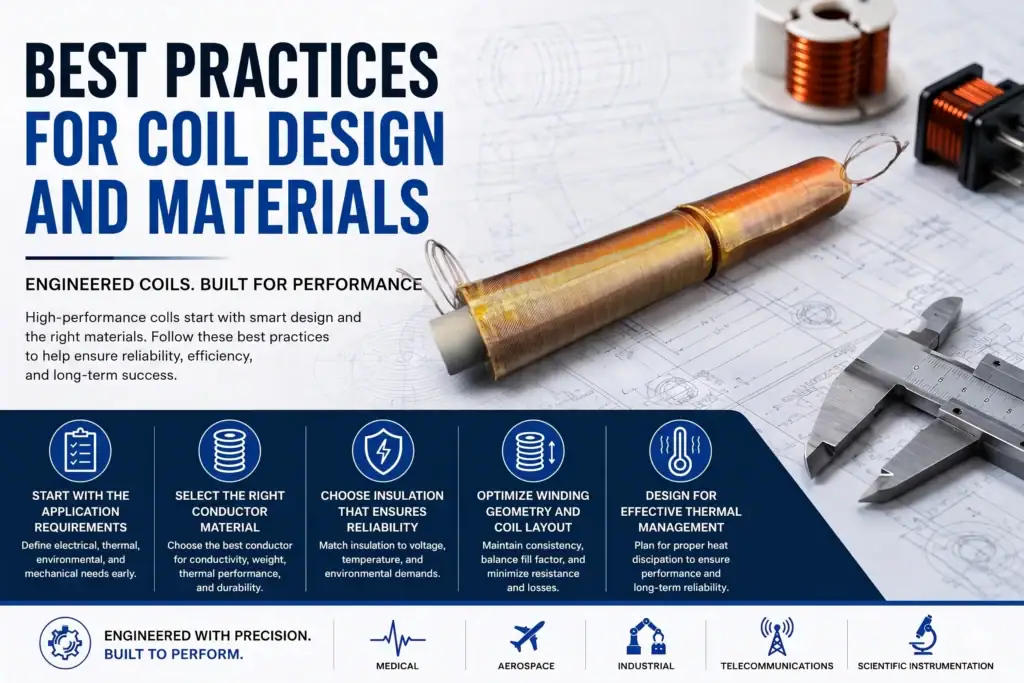
Coils play a critical role in applications ranging from medical imaging and aerospace systems to industrial automation, telecommunications, and scientific instrumentation. Whether used in RF systems, solenoids, transformers, electromagnets, or sensing devices, coil performance directly impacts efficiency, reliability, thermal stability, and overall system functionality.
At Custom Coils, every custom electromagnetic solution is engineered around the specific electrical, mechanical, and environmental requirements of the application. Successful coil design involves far more than selecting wire and winding patterns. Engineers must carefully evaluate electrical requirements, magnetic behavior, thermal conditions, mechanical stresses, and environmental factors to create a coil that performs consistently over time.
This article explores several best practices engineers should consider when designing coils and selecting materials for demanding applications.
Start with the Application Requirements
Every successful coil design begins with a clear understanding of the operating environment and system objectives. A coil intended for a high-frequency medical imaging system will require a vastly different design approach than one used in heavy industrial automation or aerospace electronics.
The engineering team at Custom Coils works closely with customers early in the development process to understand operating conditions, space limitations, electrical requirements, and long-term performance expectations before manufacturing begins.
Key considerations often include:
- Electrical load requirements
- Frequency range and signal behavior
- Space and dimensional constraints
- Thermal exposure and cooling requirements
- Environmental conditions such as moisture, vibration, or chemicals
- Compliance or industry-specific standards
Defining these requirements upfront allows engineers to make informed decisions regarding conductor materials, winding geometry, insulation systems, and thermal management strategies.
Selecting the Right Conductor Material
The conductor material forms the foundation of coil performance. Electrical conductivity, thermal behavior, flexibility, and durability all influence how efficiently a coil operates under load.
Copper remains the industry standard for most coil applications because of its exceptional electrical conductivity and thermal performance. Its flexibility and availability also make it highly suitable for precision winding and complex coil geometries. Copper is commonly used in applications where efficiency, consistent magnetic performance, and heat dissipation are priorities.
In applications where weight reduction is critical, aluminum may be considered as an alternative. Aerospace and portable electronic systems sometimes utilize aluminum conductors because of their lower mass and favorable conductivity-to-weight ratio.
At Custom Coils, material selection is based on the specific operational demands of each project, helping ensure the final coil design delivers the required balance of electrical performance, durability, and manufacturability.
Insulation Selection Impacts Reliability
Insulation systems are essential to long-term coil reliability. Improper insulation selection can lead to dielectric breakdown, overheating, premature wear, or electrical failure.
The ideal insulation material depends heavily on the application’s thermal and environmental demands. Polyurethane insulation is often selected for compact electronic applications because of its thin coating profile and ease of soldering. Polyimide insulation performs exceptionally well in high-temperature environments where thermal resistance and chemical durability are required.
Many industrial applications rely on polyester or polyesterimide insulation systems that provide a balanced combination of thermal endurance, durability, and cost efficiency.
Because insulation performance directly impacts operational lifespan, Custom Coils carefully evaluates temperature exposure, voltage requirements, and environmental conditions during the engineering process to help maximize long-term reliability
Optimize Winding Geometry and Coil Layout
Coil geometry has a direct impact on magnetic performance, resistance, efficiency, and manufacturability. Even small variations in winding consistency can influence inductance values, heat generation, and long-term stability.
Efficient winding layouts help minimize unnecessary wire length, which reduces resistance and lowers heat generation. Maintaining consistent winding tension is equally important, as uneven tension can create dimensional inconsistencies and mechanical stress within the coil assembly.
Engineers must also balance fill factor carefully. While maximizing conductor density can improve magnetic coupling and power density, excessive packing may restrict cooling airflow and increase thermal stress during operation.
Precision winding and repeatability are especially important in industries where performance tolerances are extremely tight. Custom Coils manufactures precision wound coils for applications that demand high levels of consistency, reliability, and electromagnetic accuracy.
Thermal Management Should Never Be Overlooked
Heat is one of the most common causes of coil degradation and failure. Excessive temperatures can damage insulation systems, alter electrical characteristics, and significantly shorten operational lifespan.
Effective thermal management begins during the design phase. Engineers should consider how the coil will dissipate heat under both continuous and peak operating conditions. Material selection, conductor sizing, airflow, encapsulation methods, and overall assembly design all contribute to thermal performance.
Common thermal management strategies include:
- Optimizing conductor sizing to reduce resistive losses
- Incorporating airflow or cooling pathways into assemblies
- Selecting higher thermal class insulation systems
- Using encapsulation or potting materials when appropriate
- Designing for both continuous and peak-load operating conditions
The engineering and manufacturing teams at Custom Coils understand how thermal conditions affect long-term coil reliability and work to optimize designs for stable performance in demanding environments.
Magnetic Performance Depends on Multiple Variables
Magnetic efficiency is influenced by several interconnected design factors, including wire gauge, turn count, current levels, core materials, and operating frequency.
Core material selection is especially important. Ferrite cores are commonly used in high-frequency applications because they minimize eddy current losses and support efficient RF performance. Iron cores are often preferred in power applications where stronger magnetic fields are required at lower frequencies. Air core designs may be selected in applications where magnetic linearity or reduced interference is important.
Because these variables interact closely, electromagnetic modeling and simulation can be valuable tools during the design process. Early analysis often helps engineers optimize performance before production begins.
For highly specialized applications, Custom Coils develops custom electromagnetic solutions tailored to the electrical and magnetic performance requirements of each customer’s system.
Environmental Conditions Matter
Many coil assemblies operate in harsh or highly specialized environments. Moisture, chemicals, salt exposure, vacuum conditions, radiation, vibration, and extreme temperatures can all affect long-term reliability.
Designing for environmental durability requires careful consideration of both materials and protective measures. Epoxy encapsulation, specialized coatings, hermetic sealing, and reinforced structural supports may all be necessary depending on the application.
From aerospace systems to medical and industrial applications, Custom Coils engineers coils designed to withstand demanding operating conditions while maintaining consistent performance over time.
Design for Manufacturability
A high-performing coil must also be practical to manufacture consistently and efficiently. Designs that appear effective in theory can become difficult or costly to produce if manufacturability is not considered early.
Close collaboration between engineering and manufacturing teams can help optimize tolerances, winding methods, lead terminations, and testing requirements before production begins. Early manufacturing input often improves quality consistency while reducing lead times and production costs.
By combining engineering support with precision manufacturing capabilities, Custom Coils helps customers move efficiently from prototype development into scalable production.
Testing and Validation Remain Essential
Even the most carefully engineered coil designs require thorough validation before deployment. Testing helps confirm that the final assembly performs as expected under real-world operating conditions.
Electrical testing typically includes resistance, inductance, and dielectric evaluations. Additional validation may involve thermal cycling, vibration testing, environmental stress screening, and frequency response analysis depending on the application.
Comprehensive testing helps identify potential weaknesses early and improves long-term reliability in the field. Quality assurance and performance verification remain critical components of the manufacturing process at Custom Coils.
Final Thoughts
Effective coil design requires balancing electrical performance, thermal management, material science, manufacturability, and environmental durability. Every design decision — from conductor selection to insulation systems and winding geometry — plays a role in determining long-term reliability and system efficiency.
By following proven engineering best practices and selecting materials carefully, manufacturers and design teams can develop coils capable of meeting the demands of today’s most advanced applications.
Custom Coils provides custom-engineered electromagnetic solutions for complex industrial, aerospace, medical, defense, and scientific applications where precision and reliability are critical.