
How Magnetic Actuators Support Satellite and Aerospace Systems
Comments Off on How Magnetic Actuators Support Satellite and Aerospace SystemsThe Precision Demands of Modern Aerospace
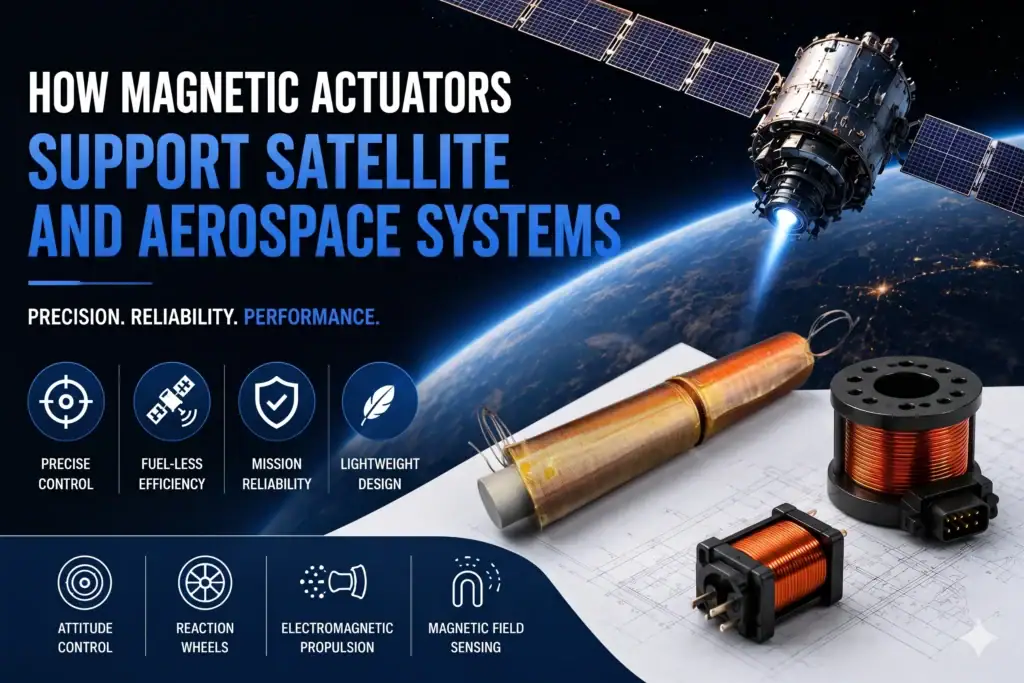
Modern aerospace systems like satellites are increasingly shifting toward electric propulsion and electromagnetic actuation. Electromagnetically powered movement systems offer a far greater degree of propulsion control, motion control, and positioning than chemically propelled systems. Unlike off-the-shelf electromagnets, custom electromagnetic components provide the optimal performance, reliability, and control necessary for mission-critical satellite applications.
Learn more about how custom-engineered electromagnetic assemblies are used in space.
Understanding the Electromagnetic Actuator in Space
Through an effect known as the Lorentz Force, an electromagnetic actuator uses a current from the magnetic field and a perpendicular force to accelerate an object through space. In this case, the electrified conductor is the propellant, in contrast to gas or liquid propulsion. The resulting helical or circular motion can be controlled by manipulating the electromagnetic field, giving ground crews precision control over the actuator.
Satellite Components: Magnetorquers for Attitude Control
Magnetorquers are a type of magnetic actuator. They interact with the magnetic field around the Earth to generate torque that satellites can use to change or maintain their orientation. Key functions of magnetorquers in attitude control include:
- De-tumbling satellites after they reach the right position
- Supporting three-axis stabilization in three-axis control systems
- De-orbiting small satellites to prepare for re-entry
- Unloading momentum from complementary control actuators
- Desaturating reaction wheels
Depending on the specific satellite application, common examples of magnetorquer types include magnetic torquer coils, bars, and air core magnetorquers.
Reaction Flywheels: Fuel-Less Angular Momentum Control
Satellites can use electromagnetic actuators in reaction and momentum wheels to manage angular momentum without using chemical-based fuel, which has downstream benefits of conserving fuel and lowering the total weight of the initial launch. Flywheels use electromagnetic coils to actively control positioning for optimal Earth observation, antenna alignment, and data link quality.
Satellite Protection and Measurement
Custom electromagnetic assemblies also play a role in the satellite’s efficiency, performance, and longevity. For example, high-accuracy electromagnetic coils can operate as sensors to measure ambient magnetic fields, collect data to monitor seismic activity, make weather forecasts, and conduct other studies with greater accuracy.
Furthermore, because electromagnets weigh far less than chemical-based systems and the fuels they need to operate, satellite manufacturers can reduce construction costs, decrease the amount of shielding on the satellites, and better harness the planet’s existing magnetosphere’s shielding capabilities. By being lighter and better at harnessing existing electromagnetic forces, satellites become more efficient and reliable.
Electromagnetic propulsion systems represent a significant leap forward in fuel efficiency for modern aerospace applications. By utilizing electromagnetic actuators and high-precision coils, these systems allow satellites to achieve complex maneuvers with minimal propellant mass, significantly extending mission lifespans.
Electromagnetic actuators support high-efficiency thrusters, such as:
- Hall Effect Thrusters: At the open end of the thruster, the plasma creates a negative charge. A radial magnetic field confines the electrons, while propellant is fed through an anode. As the propellant diffuses into the thruster’s channel, the confined electrons ionize it, and the resulting ions are accelerated between the cathode and anode to generate thrust.
- Pulse Plasma Thrusters: An electric arc is sent through fuel to transform it into plasma, which travels between two capacitor-charged plates. This process charges the plasma, generating a powerful electromagnetic field. The resulting Lorentz Force exhausts the accelerated plasma at high velocities to create thrust.
- Gridded Ion Thrusters: Negatively charged electrodes on the downstream end create an electric field that facilitates acceleration, while coaxial apertures on the electrode act as lenses to focus the ions. Upstream, positively charged electrodes serve as an accelerator grid that attracts ions to create numerous concentrated ion jets.
These applications all require electromagnetic coils that can withstand vacuum, zero gravity, and extreme temperature fluctuations. At Custom Coils, we’ve developed satellite thruster coils that provide optimal performance in space.
Why Custom Coil Engineering Is the Aerospace Differentiator
In high-stakes aerospace applications, custom coils provide the optimal performance necessary for long-term deployment. Custom Coils has over 55 years of experience creating high-performance electromagnetic components and assemblies that meet custom requirements for size, weight, power consumption, and torque in mission-critical operations.
Our designers use CAD modeling and digital simulations to streamline design, creating custom coils that prevent off-gassing in space vacuums and minimize magnetic hysteresis across wide temperature ranges. All of our products undergo robust testing protocols and come with 100% component traceability. Our facilities comply with ISO 9001:2015, ISO 13485, NEMA, and UL standards for consistent quality.
Learn More About Custom Coils’ Magnetic Actuators for Satellites and Aerospace Components
Modern satellite components rely on precision electromagnetic actuators and coils for reliable movement, positioning, and performance. Custom Coils develops magnetic actuator assemblies for aerospace and satellite component manufacturers, delivering superior propulsion and control across dozens of applications. Contact us to learn more about our custom electromagnetics capabilities, or schedule a free consultation to discuss your project.