Posted by John Quinn on | Comments Off on Multi-coil Configurations and Their Effects
With almost unlimited possible multi-coil configurations, it’s important to understand how standard multi-coil configurations interact when selecting custom coil components. While the electromagnetic properties of simpler multi-coil devices are easy to predict and control, managing more complex configurations requires a thorough understanding of how fields of basic multi-coil configurations interact.
Types of Multi-coil Configurations
Electrical engineers use various multi-coil designs to model the electromagnetic field of each configuration and determine its properties. These considerations are useful to achieve specific electromagnetic effects in various devices, and the qualities of any given multi-coil greatly affect its potential applications. The following are the most common standard multi-coil configurations, along with their associated electromagnetic properties and general applications.
Dipole Magnet: Dipole magnets are capable of producing homogeneous magnetic fields across large distances. They stimulate particle motion in a circular plane perpendicular to the electromagnetic field, which is ideal for particle accelerators. By applying multiple dipoles along the same plane (collinear to the particle trajectory), it’s possible to increasingly bend the beam’s helical direction radially.
Helmholtz Coil Configuration: A Helmholtz coil configuration is an almost completely uniform type of dipole magnet, consisting of two coils generating equal currents along the same axis. Because they have minimal variability, Helmholtz coils are useful for applications such as calibrating scientific instruments and canceling out the Earth’s magnetic field.
Quadrupole Magnet: Because individual quadrupoles cannot focus along both vertical and horizontal axes at the same time, each quadrupole focuses along one plane, and defocuses along a plane perpendicular to it. There are actually two types of quadrupoles:
1. F quadrupoles, which focus horizontally
2. D quadrupoles, which focus vertically
Placing both types of quadrupoles together directly cancels out their electromagnetic fields; however, placing them at a distance leaves certain portions of each quadrupole’s field intact, resulting in unique interference patterns. It’s then possible to control both the vertical and horizontal axes within an electromagnetic lattice produced by a quadrupole pair. By carefully spacing F and D quadrupoles, the direction and range of the magnetic beam’s focus is subject to control.
These properties make a carefully configured quadrupole pair ideal for controlling beam focus and particle generation. Depending on the type of lattice built by the interference pattern, it’s possible to send particle beams across large distances, form a complete ring, and achieve other specific effects.
Applications of Multi-coil Configurations
Electromagnetic devices often require an array of multi-coil configurations to achieve the desired effect. By combining different coils, it’s possible to control an electromagnetic field with precision control. The complexities of multi-coil systems rise with the use of less standard multi-coil configurations.
For custom, specialty coil designs, it’s critical to perform comprehensive modeling of any multi-coil configuration’s electromagnetic properties. Doing so makes numerous applications possible in the safest and most effective way while reducing unwanted electromagnetic interference.
Electromagnetic Field Effects
By altering the size, power, orientation, and placement of coils in relation to each other, basic coil configurations give way to more complex electromagnetic fields. Using different multi-coil configurations is fundamental to custom coil design, electronics manufacturing, and any application where electromagnetic residue might be problematic (such as motor shafts).
To control electromagnetic fields, it’s common to begin by designing and modifying more basic multi-coil configurations and determining their effect on the resulting electromagnetic lattice, beam direction(s), and other properties. In this way, technicians can design electromagnet coil products according to the specific needs of electronics manufacturers in numerous industries.
Contact Custom Coils for your Multi-coil Configuration Needs!
While potentially very complex, the foundations of multi-coil device configurations are relatively simple. By studying the effect of each coil on the electromagnetic field, Custom Coils’ experienced engineers achieve maximum control of these properties in our custom multi-coil devices.
If you have any need for specialty multi-coil products, request a quote from our highly knowledgeable project engineers. We can help you determine which multi-coil configuration is right for your design, including fully custom solutions.
Posted by John Quinn on | Comments Off on What are Electromagnetic Coils?
Coils are helically wound electrical wires that generate electromagnetic fields when exposed to an electrical current. They are vital parts of various devices, including electromagnets, solenoids, and inductors. A range of applications, from antennas to electric motors, rely on electromagnetic field generation from coils. Coils deliver many benefits and can be made from a diverse range of materials.
At Custom Coils, we are committed to producing high-quality, custom coils for our customers across industries. Our coil manufacturing expertise gives us the capabilities to meet your production requirements no matter the size. From design to production, we partner with you every step of the way.
What Are Coils?
A coil consists of a length of electrical wire with one or several helical turns to form a cylindrical shape. The coil wire carries an electrical current that allows the coil to function in several ways. A coil is suitable for use as a choke to provide inductance to create an electromotive force. When a core of soft iron is placed inside, coils gain electromagnetic capabilities. Solenoids are another type of coil that responds to variations in electrical currents to operate an attached plunger.
The following are applications that frequently rely on coils:
Electromagnetic Valve Actuators for Camless Engines
Electromagnets
Infrared Steering Mirrors
Latching Solenoid Coils
Magnetic Memory
Magneto-optical Disc Drives
Mini Ferrite Conductors
Motors
Pot Cores
Solenoids
Valve Actuators
Voice Coils
Variable Reluctance Speed Sensors
Benefits Of Using Coils
At Custom Coils, our high-quality coils use the best materials for dependability in critical applications, guaranteeing highly repeatable results. Our coil manufacturing processes maximize the quality of our coils while lowering production costs. High-quality coils offer longer and more reliable service with less maintenance and downtime. We test our coils to meet or exceed the highest industry standards. We also specialize in coil solutions for extreme thermal and high-power applications.
Coil Materials
Coils use copper or aluminum electrical wires to generate a magnetic field from an electrical current. Pairing a coil with a ferromagnetic material allows the coil to function as an electromagnet. Soft iron, nickel alloy, cobalt, and steel are popular ferromagnetic materials for coil-based electromagnets. They are highly responsive to magnetization, offering optimal operation. Including ferromagnetic materials in the composition of an electromagnet can increase the magnet’s power.
A magnetic field is the result of electrons forming in proper alignment and creating a magnetic domain. Ferromagnetic material forms a magnetic domain in a more uniform direction than other materials. Magnetic circuits that rely on ferromagnetic materials deliver a dense magnetic flux to amplify the coil’s magnetic field.
Coils From Custom Coils
At Custom Coils, we use a diverse range of coil winding techniques to manufacture coils for any application. Our coils are custom made to meet our customers’ specifications. We manufacture large and small volumes of coils, prototypes, and one-off products.
We offer single and multi-layer helically wound coils. Our coil winding processes include automated and random layer processes for higher-speed manufacturing, and manual and precision winding for greater accuracy. We can also use dry, epoxy, and self-bonding winding processes for coils with and without epoxy impregnation and solvents.
Partner With Custom Coils
At Custom Coils, we have been manufacturing coils with maximum quality at minimal cost for over 45 years. We deliver prototypes and product lines from small to large volumes compliant with UL, NEMA, and ISO standards. Contact us to learn more or request a quote today.
Posted by John Quinn on | Comments Off on Magnetic Levitation
Also known as magnetic suspension, magnetic levitation (maglev) occurs when magnetic fields suspend an object in the air, with magnetic force overcoming gravitational force to keep it aloft. The idea of magnetic levitation has been around since at least 1904 when Robert Goddard, an American inventor and professor, authored a paper based on magnetic levitation as a concept. Maglev transferred from theory to reality in the 1910s when Emile Bachelet, a French-born engineer living in America, filed patents for maglev technology. A half-century later, during the late 1960s, Gordon Danby and James Powell of Brookhaven National Laboratory filed a patent for a maglev train utilizing superconducting magnets to enhance magnetic field power.
Whatever the application, there are two issues to consider for successful magnetic levitation. The first is the amount of upward force needed so that an object can defy gravity, and the other is the stability necessary to prevent neutralized lift through unexpected flipping or sliding. Maglev trains are among the most prominent uses of magnetic levitation, and they are capable of maintaining sufficient lifting force and stability for effective transportation.
How Do Maglev Trains Work?
A maglev train utilizes superconducting magnets set into each of a train car’s four corners, as well as a specialized track. A magnet becomes superconducting when its temperature reaches -450° F. This frigid temperature enables these magnets to produce magnetic fields with as much as 10 times the strength of the fields that regular electromagnets produce. It’s this capability that gives the maglev trains the ability to levitate and propel forward. The magnets located on a train car’s front two corners have their north poles facing out, with the back magnets positioned to have their south poles out.
As for the special track, or a guideway configured in a U-shape, it has metallic loops consisting of aluminum or other conductive metals dispersed along its concrete walls. These loops interact with the enhanced magnetic fields, generating an electric current that, in turn, creates an additional field.
There are three loop varieties that engineers place strategically along the guideways. One type produces a magnetic field that causes a train to levitate approximately 5 inches above the track. The second helps to stabilize train cars horizontally. In both cases, the loops use the force of magnetic repulsion to ensure that the train stays in its appropriate position on the track.
The last loop type is for propulsion, utilizing power from the alternating current as well as magnetic repulsion and attraction forces to move the train forward. When operators electrify the propulsion loops on the guideway, the resulting magnetic fields propel the train forward by pulling on the front magnets and pushing on the back. Magnets of matching poles repel when they face one another.
Benefits of Maglev Trains
Maglev trains offer an array of benefits to the transportation sector. These include:
Increased speed. High-speed maglev trains can achieve and maintain speeds of 375 mph safely.
Enhanced safety. These innovative trains rule out a number of the safety concerns inherent in traditional trains. For example, all maglev trains on the same track would have no risk of colliding because all the trains are moving at the same speed. Maglev trains also eliminate the chance of taking corners at sufficient speeds to derail, as magnetic forces only become stronger as the train moves from its standard positioning between the walls of its guideway and will effectively pull the train back.
Smooth movement. Air is the only factor providing friction, so despite the speed, passengers won’t feel the usual turbulence associated with train travel. Also, as these trains have minimal contact with their tracks, this reduces overall vibration.
Noise reduction. With minimized vibration comes the added benefit of reduced noise for passengers.
Decreased downtime. Maglev trains experience fewer breakdowns due to mechanical issues than standard trains, which makes sense given the reductions in friction and vibration.
Custom Coils: A Magnetics Industry Leader
Magnetic levitation trains have the capability to successfully and safely maintain lift and achieve propulsion through the force of superconducting magnets and magnetic fields. Given their cost to build, maglev train use is not widespread, but magnetic levitation is an innovative concept that has the potential to revolutionize rail travel.
At Custom Coils, our team is committed to new ideas. We’ve been custom-designing and manufacturing magnetic components in the USA since 1967. For 55 years, we’ve continued to serve diverse industries ranging from transportation to communication and agriculture to aerospace with customer service that is second to none. Contact us today to experience the Custom Coils difference and learn more about our capabilities for innovative magnetic products.
Posted by John Quinn on | Comments Off on Electrical Coil Design: Thermal Challenges
Electric coils conduct energy and allow for inductance to counter or control the flow of current. The coils are constructed from wires (made from conductive materials like copper) which may be wound around a cylinder, disk, or toroid-shaped ferromagnetic core or as a self-supported structure (wire only). While electric coils operate based on simple principles, manufacturers can design and construct electric coils with different capabilities for a wide range of consumer, commercial, and industrial applications. At Custom Coils, we specialize in producing coils for the following industries:
Manufacturers consider these four design elements to create custom electrical coils and overcome thermal challenges:
Wires
The basis of any electromagnet starts with a conductor wrapped in a defined shape/structure.The shape, thickness, and length of the wire all factor into the coil’s magnetic field, the energy loss, and the ability of the coil to complete different functions. The resistance of the wire and the insulation required for the coil may dictate the type of wire used.
For electrical coils used in harsh or demanding environments, electroplated wires can withstand potential deterioration. Electroplating processes coat the wires with materials like gold, nickel, or silver, as well as an insulative coating.
Insulation
Electrical coils also need insulation to isolate the windings as well as protect the wires from extreme heat and thermal damage. It sits between the wires so they don’t make contact and fail due to shortage. Manufacturers can help select the right type of insulation for an electrical coil based on the coil’s anticipated thermal capacity, the wire gauge, and the product’s applications.
Types of Coil Winding
Manufacturers wind wires around the ferromagnetic core in a precise shape and design to fulfill different functions. The type of coil winding in an electrical coil will be determined based on the:
Insulation
Quality
Inductance
Type of magnetic field being generated
Core Material
The coil’s core is an essential element. Different types of core materials produce magnetic fields of different strengths and affect the coil’s inductance.
Thermal Challenges
Cooling and Thermal Control
Often the dimensional constraints and operational requirements of the electromagnet produce a coil that will heat up beyond temperature limits of the materials or system it is operating in.
A coil’s magnetic field is directly driven by the number of turns on the coil and the amount of power input (amps). Typically, the magnetic field requirements for the coil drive specific turn count and power requirements to generate the desired field; however, the coil dimensions constrain the number of turns that can be wound in the given dimensional space. This will require higher power input to the coil and may drive the temperature beyond the material or operational limits. Additional cooling may be required to draw heat out of the coil.
Cooling Applications:
Heat Sink: A structural holder (as defined above) can often act as a heat sink to draw heat away from the coil. For example, a coil wound in a copper bobbin (copper has a high thermal conductivity) will conduct heat out of the coil through the bobbin. Often times, heat sinking material is used, along with convection (fans, air flow) to provide enough cooling flow out of the coil.
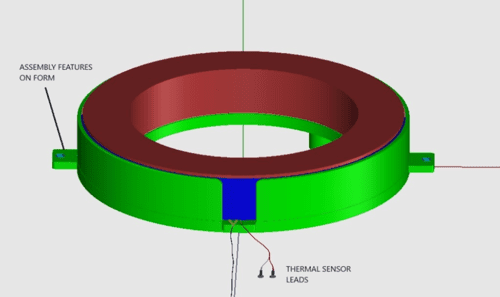
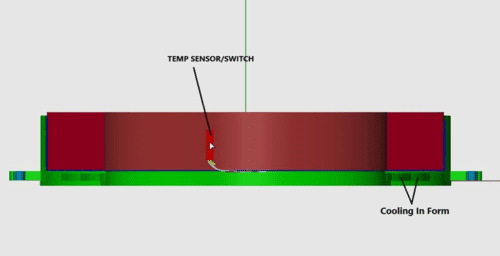
Heat Sink with Cooling: Similar to above, if heat sink with convection not enough to control temperature, a cooling path can be designed into a structural holder for the coil.
In-line Cooling: Hollow core conductors are used to wind the coil and act as the electrical path and the cooling path. This allows for cooling to run through the coil itself and they are typically used in high-power applications.
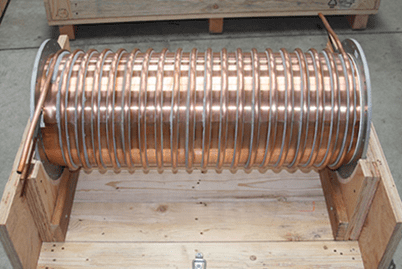
Copper Tube Cooling: Depending on the size of the coil, copper tubing can be applied on the ID, OD, or in the center of the coil windings.
Temperature Sensor/Cut-off
Thermal sensors can be applied to a coil to monitor temperature and control operation when a coil gets too hot or rises beyond operational limits.
Sensor Types
Thermocouples: Thermocouples can be applied externally on the coil or applied during winding at various internal points in the coil. Thermocouples monitor temperature and allow user flexibility in regard to actions taken when various temperature situations occur. They are typically integrated into the power supply system to monitor the coil temperature and determine whether to decrease power and/or shut down the system at various temperatures.
On/Off Temperature Switch: These are on/off switches made to shut off power at a specified temperature. These can typically be applied externally on the coil and/or in line with the lead wire to the power source.
Custom Electrical Coils From Custom Coils
At Custom Coils, we specialize in creating high-performance electrical coils with sufficient cooling solutions for long-term operations. Contact us today to learn more about our capabilities or request a quote to start your order.
Posted by John Quinn on | Comments Off on What is High-Density Plasma Technology?
High-density plasma domes have traditionally been used as decorative objects due to their unique lighting effects, but they are also an integral part of the semiconductor manufacturing industry. This blog will explain high-density plasma domes and their modern applications in further detail.
High-Density Plasma Domes
Also called a plasma globe, a plasma dome is a clear glass ball or container filled with a mixture of different noble gasses and a high-voltage electrode at the center. Plasma forms within the container when you apply voltage. Consequently, plasma filaments extend from the central electrode to the inner walls of the glass insulator. The result is the appearance of several beams of colored light.
Different variations of high-density plasma domes exist. The most common variation is a clear glass sphere filled with gas mixtures at close to atmospheric pressure. These gas mixtures may include neon, krypton, xenon, and argon.
The globes run on high-frequency alternating current. In most cases, the driving circuit is a type of power inverter, where a lower-voltage direct current supplements the inverter’s output with the help of a high-voltage, high-frequency transformer.
Applications of High-Density Plasma Domes
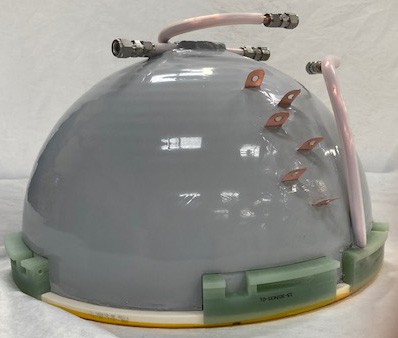
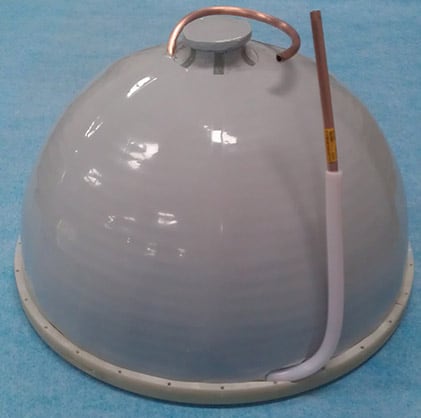
A high-density plasma dome is a single unit made up of several components, including:
A ceramic bell jar
A cooling/RF coil
Ground tabs/slugs
Machine parts
A non-conductive elastomer
In semiconductor applications, high-density plasma chemical vapor deposition (HDP-CVD) is a technique that creates the crucial layers of insulation that separate and protect the electrical components. High-density plasma domes can be categorized based on the type of gasses they contain and their applications, which typically include RF assemblies and silicon wafers.
In addition to decorative and recreational purposes, high-density plasma globes can be part of an institution’s lab equipment for demonstration purposes. In particular, high-density microwave plasma machines can produce ions and free radical species. In these applications, the machine is made of a plasma source, the circuit, and the applicator.
High-density plasma domes can also be used in silicon wafer and RF assembly applications, where they are susceptible to damage with regular use. That’s why it’s important to partner with a reputable refurbishment and repair company.
When using high-density plasma domes, exercise caution especially in the following conditions:
Avoid bringing flammable items near the globes.
The domes may emit certain frequencies that interfere with phone and Wi-Fi signals. Therefore, keep them away from such areas.
Since they radiate electromagnetic waves, avoid operating the domes near people with pacemakers.
Custom Coils Capabilities
If you’re looking for high-density plasma dome repairs and refurbishments, Custom Coils is here to help. With over 30 years of experience, we are experts at developing high-quality, repeatable production processes for high-density plasma domes. We have shipped over 10,000 high-density bell jar parts, and we remain ready to take on any repair or refurbishment project, no matter how challenging or complex. What sets us apart from other suppliers is that we understand how critical parameters relate to material makeup.
Posted by John Quinn on | Comments Off on Real World Applications of Electromagnets
As common as they are, electromagnetic devices are not as widely understood. An electromagnet uses an electrical current to generate a magnetic field. The strength of that field is directly proportional to the level of current supplied to the magnet, and the field’s polarity can be flipped by changing the direction of the electrical current. Electromagnets serve a variety of purposes in many day-to-day technologies, particularly in electromechanical and electronic devices.
We’ll cover some of the most common uses of electromagnets in the world today, both in consumer products and for industrial applications, making many modern technologies possible.
Real World Electromagnet Applications in Electronics
Most people don’t directly see electromagnets in their daily life, but they are no less often used. Electromagnets are found in countless consumer and commercial products, including:
TVs
Audio Equipment
Computers
Cars
Elevators
Copy Machines
MRI/CT Scan Machines
Real World Electromagnet Applications in Power Generation
Generating power involves converting sources of primary energy into electric power. An electric generator stores mechanical energy in the form of electrical energy by using a wire coil in a magnetic field. This is done by rotating the coil, which induces a current, and industrial-scaled applications accomplish this with a large, rapidly spinning turbine to produce massive amounts of electrical current.
This electrical energy can be stored and converted back into mechanical energy for a variety of purposes – such as running a motor. To do so, an electromagnet is supplied with a reverse current, creating a magnetic field that causes the magnet’s coil to spin, along with anything connected to it.
Electromagnets make it possible to convert mechanical energy into electricity, and then back into mechanical energy. The electromagnetic device that converts these energies is called an actuator, which consists of a stationary and a moving component (such as a rotor), where the magnetic fields produce torque and force that can be harnessed. This same principle makes it possible to use an electromagnet’s induction coil to measure the magnetic field itself, making electromagnets capable of functioning as sensors.
To summarize, electromagnets are used in four different ways in the power generation process:
Generators
Motors
Actuators
Sensors
Real World Electromagnet Applications in Medicine
Medical devices such as Magnetic Resonance Imaging machines (MRIs), use magnets thousands of times more powerful than your average kitchen magnet to generate signals in the radio-frequency range, which the device then measures and translates into images. This results in highly detailed pictures of bones, organs, and various tissues.
Magnets are also applied in some cancer treatments, where a doctor injects magnetically sensitive fluid into the area around the tumor and uses a powerful magnet to generate heat in the body. The goal is to kill the cancer cells without harming the healthy tissues.
These are just two common medical uses of magnets – others include:
Scanners
X-ray equipment
Dialysis machines
Disinfectant dispensers
Electromagnetic therapies
Real World Electromagnet Applications in Aerospace
Aerospace engineers have developed an almost entirely separate field of magnetics. Specialized uses involve sending finely controlled current and voltage to receiving systems to maintain altitude and other flight dynamics. In reverse, this also enables them to track the location and flight path of various aircraft and devices.
Much of aerospace engineering would not be possible without electromagnetic technology. Electromagnets power many standard and specialized aerospace devices, such as:
Flight control covers for both commercial and combat aircraft
Missile programs
Aircraft loudspeakers
Traveling-wave tube (TWT) radar
Permanent Magnet (PM) generator rotor assemblies
Fuel pumps
Flow regulators
Cryogenic magnets suited for space environments
Magnetic holders for aircraft seats
Position-calibration and speed sensors
Air-compressor components
Motorized generators
Tachometer generators
Electromagnets from Custom Coils
Not many technologies are as ubiquitous to modern life while remaining largely hidden from direct experience as electromagnets. Just as electromagnetic devices have driven much of modern technology forward without being often credited as such, Custom Coils, Inc. has been quietly and dutifully driving the electromagnetic industry forward since 1978.
With a highly customer-centric business model, our expert engineers work closely with every client to design and manufacture precision-engineered electromagnets for a wide variety of end uses. For any questions or to let us know about your electromagnetic needs, don’t hesitate to request a quote or contact us.
Posted by John Quinn on | Comments Off on Inductors vs. Electromagnets: Applications and Capabilities
Inductors and electromagnets are widely used components in electrical devices such as motors, generators, and transformers. While both components utilize a wire coil to establish a magnetic field, they each have functional differences that influence their suitability for a given application. Here, we highlight their similarities and differences while providing examples of how each is used in various electrical and electromechanical devices.
What are Inductors and Electromagnets?
Inductors
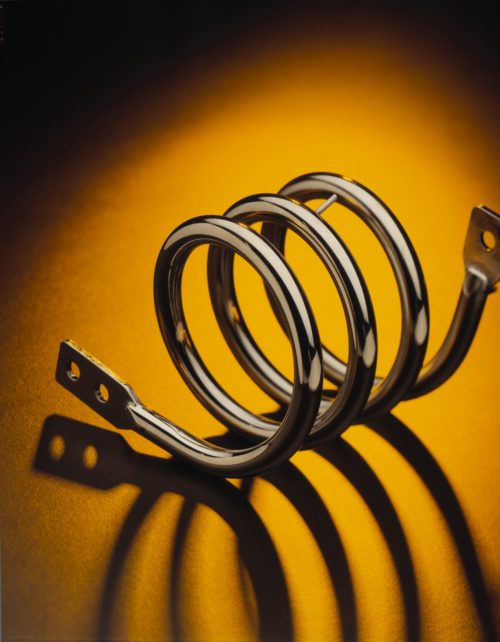
An inductor is a two-terminal electrical component consisting of a wire wound into a coil. When electricity is applied to the coil, a magnetic field forms and gradually increases in strength. This magnetic field eventually collapses and is converted into electrical energy that is released back into the circuit.
The ability of inductors to temporarily store energy in an electromagnetic field makes them useful for:
Slowing current surges and spikes in circuits
Storing and delivering energy to a circuit
Impedance matching
Inductors are categorized into the following types:
Coupled inductors featuring two coils connected by electromagnetic induction
Multi-layer inductors featuring a layered coil wrapped around a core
Ceramic core inductors featuring a dielectric ceramic core
Molded inductors created using plastic or ceramic housings
Electromagnets
Like inductors, electromagnets consist of a coiled wire through which electricity flows to produce a magnetic field. The strength of the magnetic field is proportional to the number of turns in the coil. To further increase the magnetic field’s strength, the coil is often wound around a ferromagnetic or iron core.
In contrast to permanent magnets, the strength of an electromagnet’s magnetic field can be adjusted by modifying the amount of current flowing through the coil. The magnetic field can also be “turned off” by removing the electricity source from the magnet. This controllability makes electromagnets ideal for everything from powering electric doorbells to lifting and moving large pieces of metal.
Electromagnets include three main types:
Resistive electromagnets featuring copper wires twisted around an iron core
Superconducting electromagnets featuring cryogenically cooled coils of superconducting wire
Hybrid electromagnets featuring a combination of resistive and superconducting electromagnets
Applications of Inductors and Electromagnets
Inductors
One of the most well-known uses of inductors is in induction motors, where they generate the magnetic field required to rotate the motor’s shaft. The speed of the shaft’s rotation is directly proportional to the frequency of the power supply. Other inductor applications include:
Filtering/blocking. In electrical circuits, inductors can filter, choke, or block higher-frequency alternating currents and smoothen output voltages.
Transformers and converters. Inductors transfer and store energy in transformers and power converters.
Tuning circuits. In tuning circuits, inductors allow a specific frequency to be selected.
Sensors. Contactless electronic proximity sensors utilize inductors in the head of the sensor to enable inductive sensing.
Ferrite beads. When used in ferrite beads, inductors help reduce electromagnetic interference in audio circuits.
Electromagnetic relays. Electromagnetic relays are automatic switches that use electromagnetic induction to open or close the switch during operation.
Electromagnets
The power and versatility of electromagnets make them an essential component of everything from small consumer electronics to mass-transit systems. In maglev trains, for example, electromagnets line the undercarriage of the train to levitate it above the guideway. Other applications of electromagnets include:
Motors and generators
Electric doorbells and buzzers
Magnetic locks
Headphones and speakers
Induction heating systems used in cooking and manufacturing equipment
Medical equipment such as MRIs and heart monitors
Magnetic recording technology and data storage devices such as hard disks and tape recorders
Laboratory research equipment such as mass spectrometers
Particle accelerators
Magnetic separation equipment
Industrial lifting equipment
Custom Inductors and Electromagnets from Custom Coils
Inductors and electromagnets provide essential functions in a range of electrical systems and electronic devices. At Custom Coils, we design and manufacture custom inductors and electromagnets according to specific field requirements and performance expectations. From high-quality materials to expert design recommendations, our in-house resources and experience allow us to create long-lasting products for nearly any electrical application.
To learn more about our inductor and electromagnet design capabilities, please contact us today or request a quote.
Posted by John Quinn on | Comments Off on Types of Inductors
An inductor is one of the basic electrical components commonly used in electric circuits. Typically, an inductor consists of an electrical conductor wound into a coil, often including an iron core. The inductor stores energy in a magnetic field when current flows through it. This magnetic field induces an electromotive force (in the form of voltage) that opposes any change in current. are common in radio frequency systems, where they conduct currents and reduce feedback and interference. In circuits, inductors are crucial in controlling electrical flow.
Custom Coils produces a wide range of inductors and can work with you throughout the product development life cycle to customize inductors for your application. As you review your options and specifications, consider the following types of inductors.
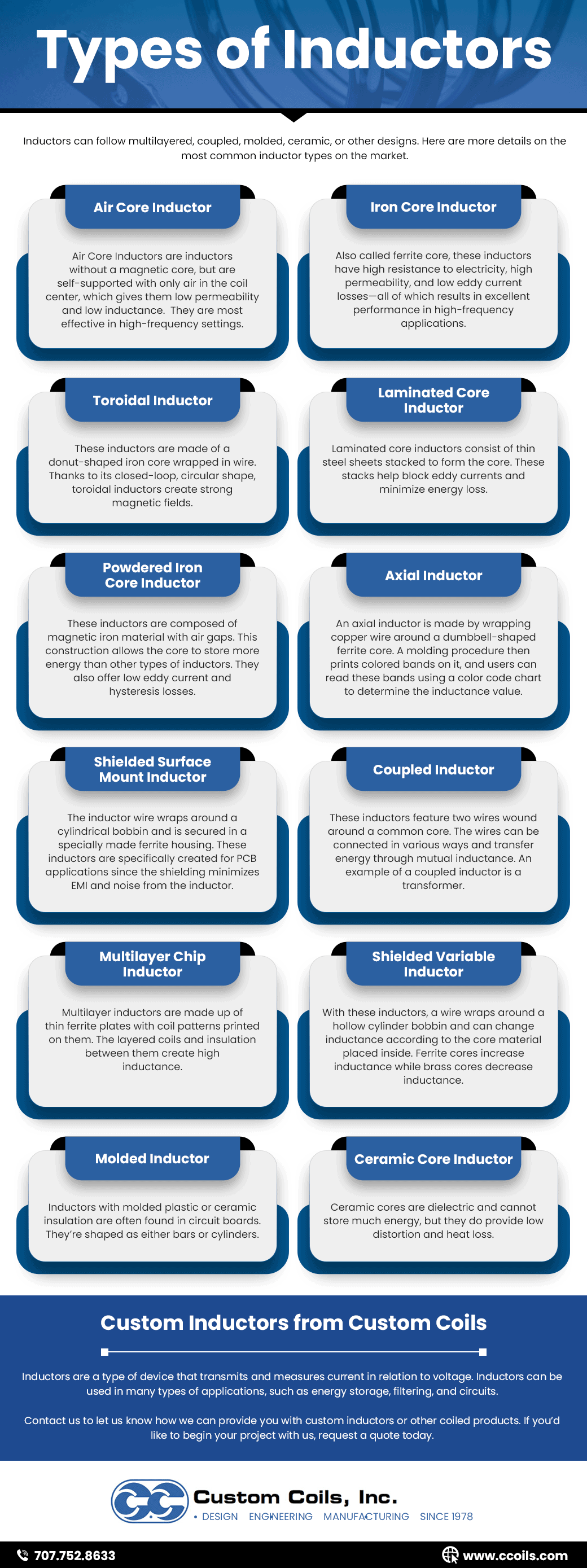
Click to Enlarge
Types of Inductors
Inductors can follow multilayered, coupled, molded, ceramic, or other designs. Here are more details on the most common inductor types on the market.
Air Core Inductor
Air core inductors are hollow, which gives them low permeability and low inductance. They are most effective in high-frequency settings.
Iron Core Inductor
Also called ferrite core, these inductors have high resistance to electricity, high permeability, and low eddy current losses—all of which results in excellent performance in high-frequency applications.
Toroidal Inductor
These inductors are made of a donut-shaped iron core wrapped in wire. Thanks to its closed-loop, circular shape, toroidal inductors create strong magnetic fields.
Laminated Core Inductor
Laminated core inductors consist of thin steel sheets stacked to form the core. These stacks help block eddy currents and minimize energy loss.
Powdered Iron Core Inductor
These inductors are composed of magnetic iron material with air gaps. This construction allows the core to store more energy than other types of inductors. They also offer low eddy current and hysteresis losses.
Axial Inductor
An axial inductor is made by wrapping copper wire around a dumbbell-shaped ferrite core. A molding procedure then prints colored bands on it, and users can read these bands using a color code chart to determine the inductance value.
Shielded Surface Mount Inductor
The inductor wire wraps around a cylindrical bobbin and is secured in a specially made ferrite housing. These inductors are specifically created for PCB applications since the shielding minimizes EMI and noise from the inductor.
Coupled Inductor
These inductors feature two wires wound around a common core. The wires can be connected in various ways and transfer energy through mutual inductance. An example of a coupled inductor is a transformer.
Multilayer Chip Inductor
Multilayer inductors are made up of thin ferrite plates with coil patterns printed on them. The layered coils and insulation between them create high inductance.
Shielded Variable Inductor
With these inductors, a wire wraps around a hollow cylinder bobbin and can change inductance according to the core material placed inside. Ferrite cores increase inductance while brass cores decrease inductance.
Molded Inductor
Inductors with molded plastic or ceramic insulation are often found in circuit boards. They’re shaped as either bars or cylinders.
Ceramic Core Inductor
Ceramic cores are dielectric and cannot store much energy, but they do provide low distortion and heat loss.
Inductor Applications
The following are popular applications for each inductor.
Air Core Conductor
RF tuning coils
Filter circuits
Snubber circuits
TV and radio receivers
Iron Core Conductor
Transformers
High-frequency applications
Toroidal Inductor
Medical devices
Industrial controllers
Switching regulators
AC circuits
Output filters
Laminated Core Inductor
Electric vehicle onboard chargers
Noise and line filters
CH/CL filter chokes for signals
Transformers
Powdered Iron Core Inductor
Transformers
DC inductors
Axial Inductor
Line filters
Boost converters
Shielded Surface Mount Inductor
Mobile and desktop devices
Servers
POL converters
Power supplies
Battery-powered gadgets
DC/DC converters in distributed power systems and field-programmable gate arrays
Coupled Inductor
Cuk, flyback, and single-ended primary-inductor converters
Transformers
Multilayer Chip Inductor
Bluetooth
Wireless LANs
Motherboards
Wearables
SBCs
Shielded Variable Inductor
Automotive applications that comply with AEC-Q200 regulations
Molded Inductor
Circuit boards
Ceramic Core Inductor
High-frequency applications
Small-signal filtering
LC filter circuits
Custom Inductors from Custom Coils
Inductors are a type of device that transmits and measures current in relation to voltage. Inductors can be used in many types of applications, such as energy storage, filtering, and circuits.
Contact us to let us know how we can provide you with custom inductors or other coiled products. If you’d like to begin your project with us, request a quote today.

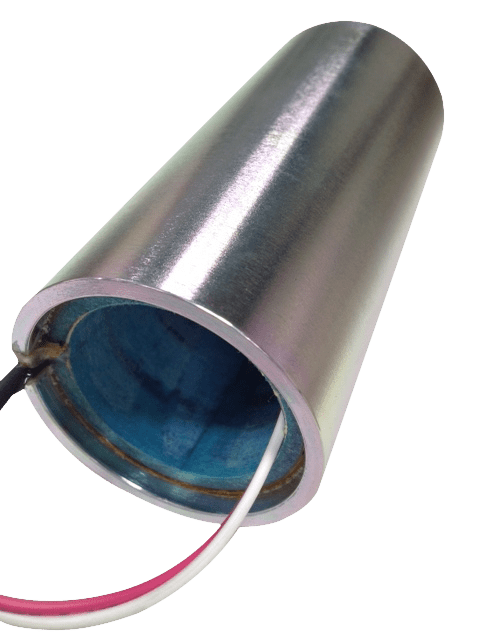
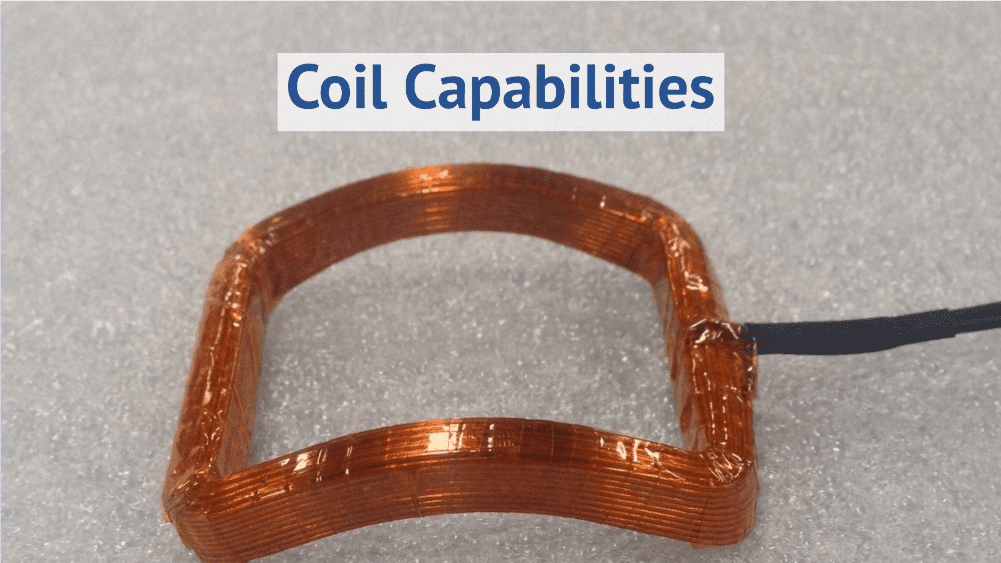

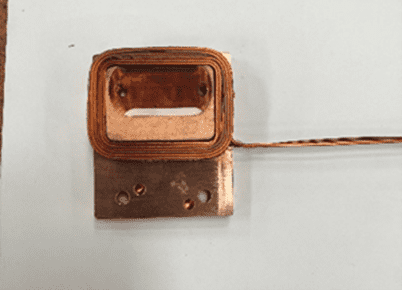
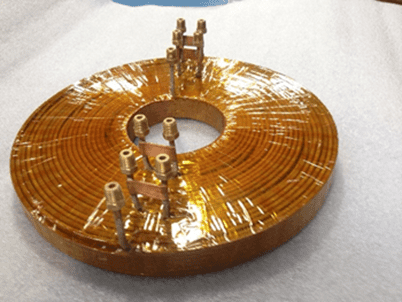
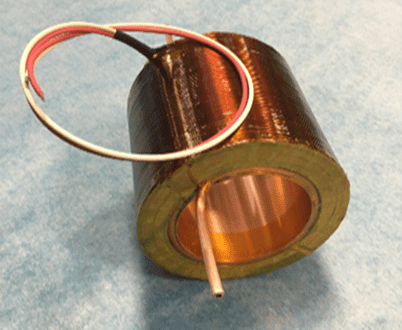
 A high-density plasma dome is a single unit made up of several components, including:
 When using high-density plasma domes, exercise caution especially in the following conditions: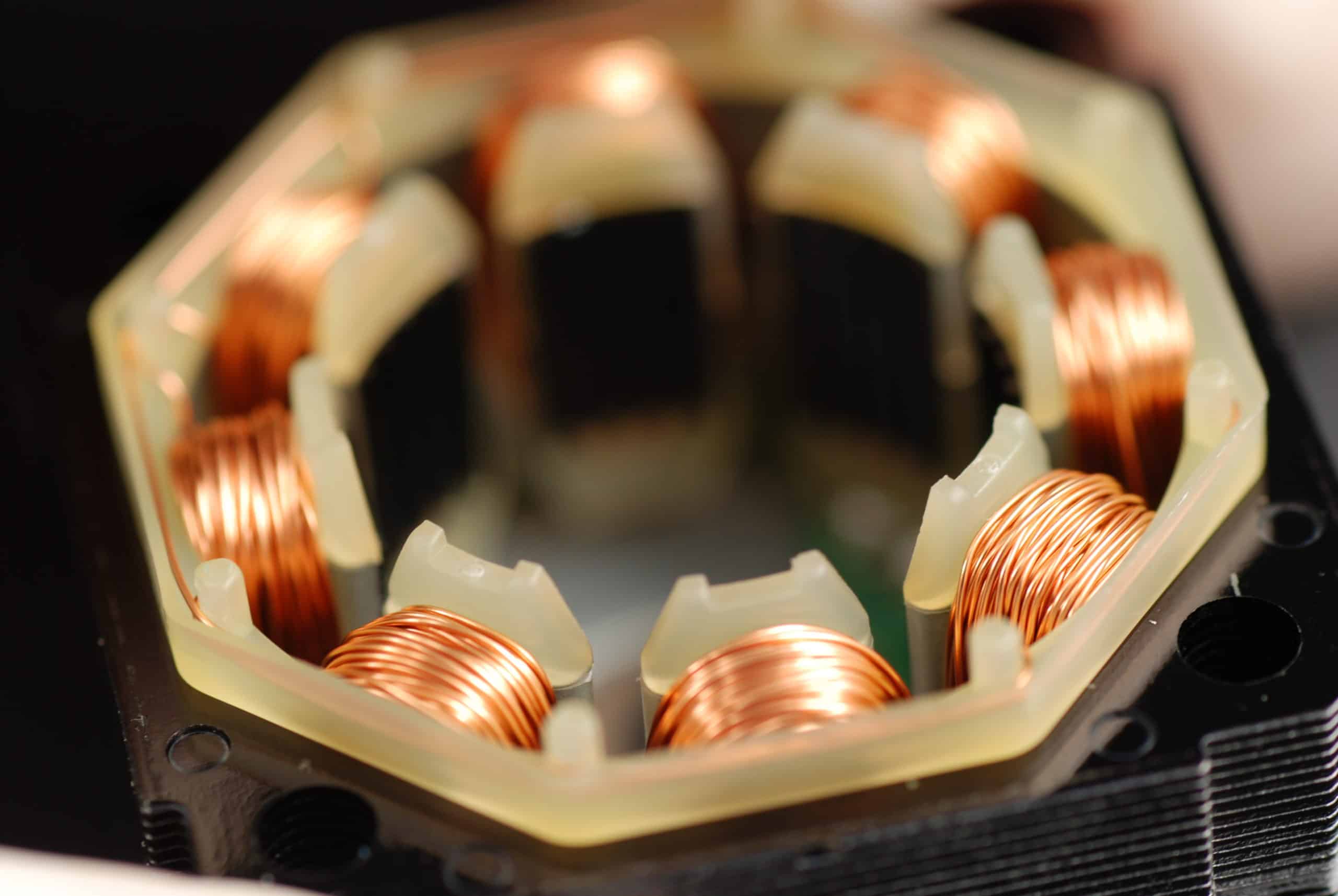
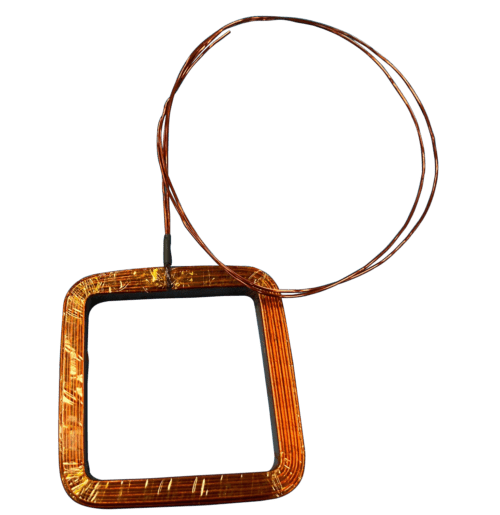
 An inductor is a two-terminal electrical component consisting of a wire wound into a coil. When electricity is applied to the coil, a magnetic field forms and gradually increases in strength. This magnetic field eventually collapses and is converted into electrical energy that is released back into the circuit.
 Like inductors, electromagnets consist of a coiled wire through which electricity flows to produce a magnetic field. The strength of the magnetic field is proportional to the number of turns in the coil. To further increase the magnetic field’s strength, the coil is often wound around a ferromagnetic or iron core.