
Quantum computers operate on fundamentally different principles than classical systems. Unlike classical bits, which only exist in either a 0 or a 1 position, qubits can exist in a superposition state, which represents 0, 1, and all positions in between. This unique property enables quantum computers to solve complex problems far beyond the capabilities of traditional computers.
Learn more about the importance and challenges of qubit control and how precision electromagnets enable accurate qubit manipulation.
What Is Qubit Control?

Qubit control refers to the precise manipulation needed to execute a specific logic operation. For superconducting qubits like transmon or fluxonium designs, this manipulation occurs through carefully shaped flux or microwave pulses that accurately rotate the qubit’s state vector on the Bloch sphere.
Why Is Qubit Control Important?
Quantum systems perform complex calculations at extremely high speeds. However, this power requires ultra-precise qubit control. Even minor interference can disrupt a qubit’s quantum state, causing computational errors.
Understanding what validation testing means for quantum systems becomes critical here. Engineers must verify that control signals produce the intended quantum states by measuring gate fidelities, readout accuracy, and coherence times. This validates qubit performance prior to use in real-world applications.
Challenges of Qubit Control
Controlling qubits differs fundamentally from manipulating classical bits, which only toggle between 0 and 1. A qubit’s 0, 1, or superposition state demands exceptionally fine control, making quantum systems engineering one of the most challenging fields in modern physics.
These are some of the primary challenges of qubit control:
- Decoherence. This refers to a qubit losing its quantum properties due to its interactions with the environment. Decoherence can quickly cause errors, limiting the available time for a given quantum computation. Thus, maintaining qubit coherence for sufficient periods is a crucial technical requirement of any qubit control system.
- Quantum gate fidelity. Achieving gate fidelities above 99.9% requires exact control over the electromagnetic environment, which is why quantum computing hardware demands precision-engineered components. Without high gate fidelity, small errors in state-change operations can accumulate and cause significant computational errors.
- Environmental sensitivity. Even slight temperature fluctuations, electromagnetic interference, and mechanical vibrations can degrade qubit performance.
How Do Precision Electromagnets Enable Qubit Control?
Quantum computing control hardware relies on electromagnets that may serve various functions across quantum architectures. Here are some examples of precision electromagnet applications in qubit control:
- Neutral-atom and trapped-ion quantum computers rely on precision electromagnets to contain atoms within vacuum chambers, where microwaves change their quantum states.
- In quantum computing control systems, electromagnetic fields and microwaves also control the movement and activity of superconducting and semiconducting qubits. The more precise and consistent the electromagnetic field, the higher the gate fidelities.
- Particular qubits, such as nitrogen-vacancy centers in diamond, need the help of electromagnets to communicate with one another through magnons.
In addition to developing more advanced precision electromagnets, researchers are exploring other strategies to overcome qubit control challenges:
- Quantum error correction codes. This involves encoding information across several qubits so that even if some qubits are compromised, the necessary information can still be retrieved accurately.
- Superconducting materials. Operating at cryogenic temperatures, superconducting qubits demonstrate longer coherence times, reduce thermal noise, and improve overall stability.
- Improved shielding. These advanced systems protect qubits from electromagnetic interference, temperature fluctuations, and cosmic rays.
- Pulse shaping. These quantum control techniques are being refined to more precisely control qubits with external fields.
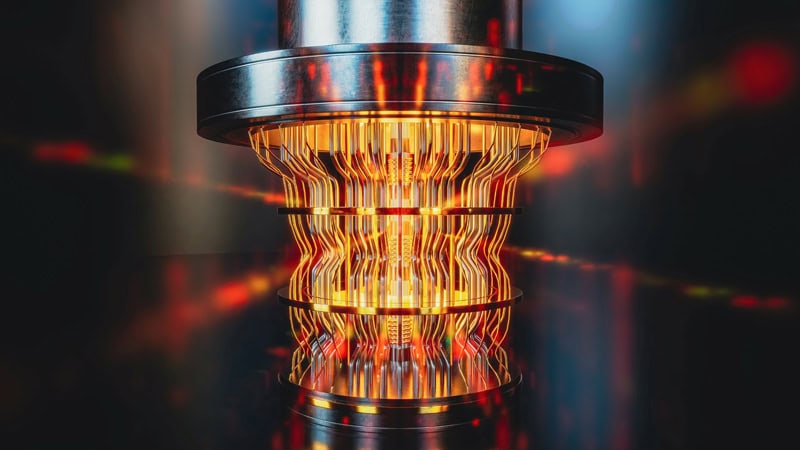
Applications of Qubit Control in Quantum Computing
Qubits are implemented in several types of computing hardware, each requiring specialized quantum control systems:
- Neutral atom quantum computers. These trap individual atoms using laser beams or electromagnetic fields, which manipulate the neutral atoms to control the qubits.
- Trapped ion quantum computers. These immobilize charged ions in vacuum chambers using electromagnetic fields, achieving high gate fidelities, long coherence times, and low error rates.
- Superconducting quantum computers. These use superconducting materials and circuits cooled to near absolute zero. Electromagnets generate the precise pulses needed to control individual qubits.
- Spin qubit quantum computers. These computers encode information in the spin of electrons in semiconductor materials. Precision electromagnets create the field environments necessary for long coherence times.
Custom Coils: Your Engineering Partner in Quantum Computing
Qubit control remains one of the defining challenges in quantum computing. Decoherence, gate fidelity, and environmental sensitivity all demand extreme precision from quantum computing hardware components.
Custom Coils manufactures precision electromagnetic coils for quantum computing applications. We work with quantum researchers and engineers developing hardware for trapped-ion systems, superconducting qubits, neutral-atom computers, and spin qubit platforms. Our ISO 9001:2015 certified processes support the exacting requirements of quantum systems engineering.
We provide custom design, prototyping, production, and testing capabilities for electromagnetic assemblies, driving the future of quantum computing applications. Contact us or schedule a free consultation to discuss your project requirements.


